Technical architecture · production design
How Prod AI runs in production.
Five planes with one job each. The control plane decides, sandboxes run untrusted code, the runtime serves live apps, and every model call and every agent action passes a gateway that can price it, cap it or ask a person first. The prototype you can click today implements the product surface of this design; the table at the end says exactly which parts are real.
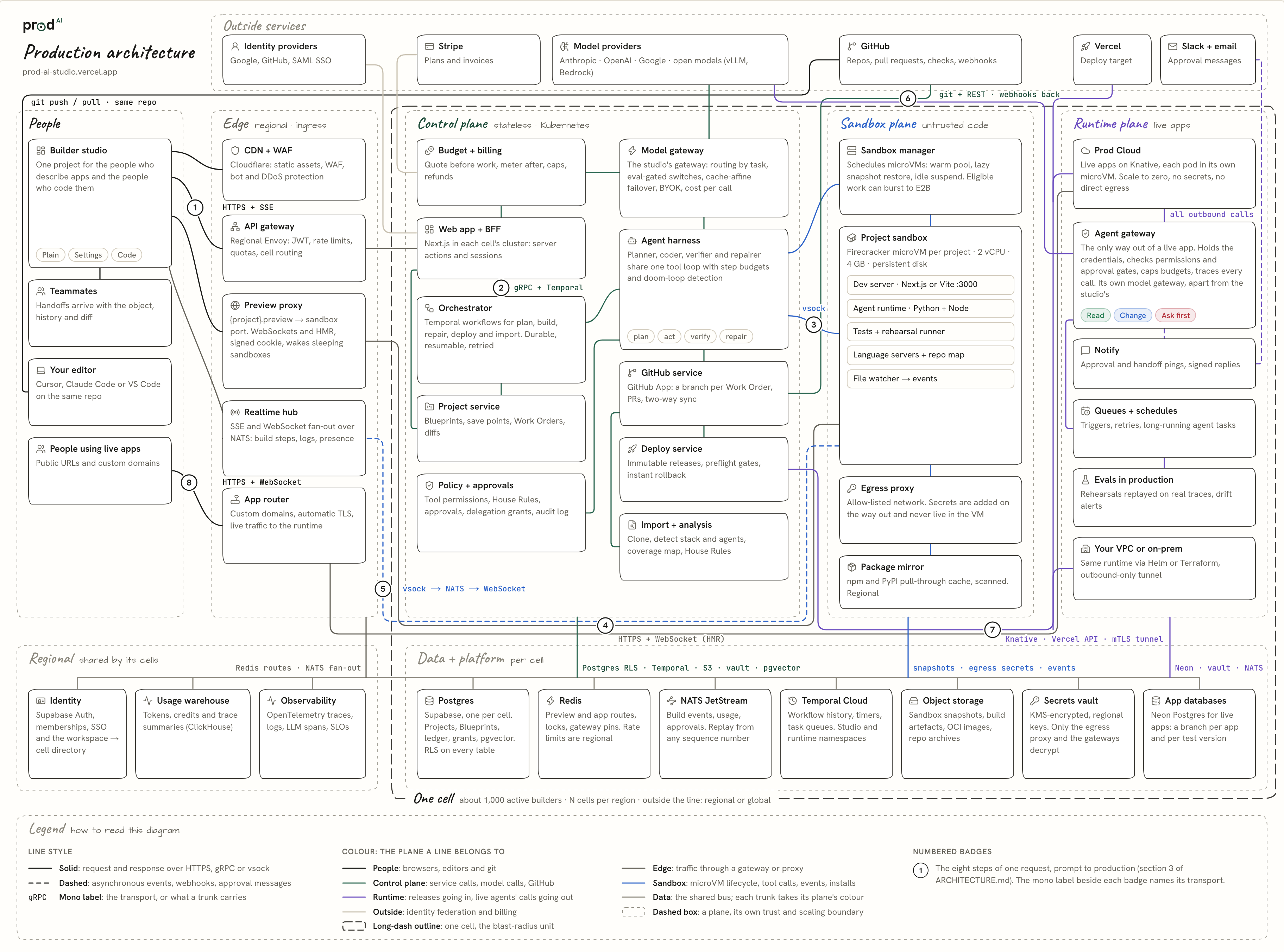
The eight flows on the diagram
Describe
The studio sends the brief through the API gateway. Nothing runs yet: the planner returns a Blueprint and a priced Work Order.
Plan
The orchestrator starts a durable workflow. The harness asks the model gateway, which picks a model per task and meters every call.
Build in a sandbox
Approved work runs inside the project's microVM: write files, install, run, test, rehearse agents. Every step is checkpointed.
Live preview
The preview proxy maps the project's subdomain to the sandbox dev server, including WebSockets for hot reload.
Show the work
File, test and step events stream back through the realtime hub, so people see progress in plain English, not a spinner.
Branch + PR
Each Work Order becomes a branch and a pull request through the GitHub App. Engineers' pushes sync back into the Blueprint or become code they own.
Ship
Preflight passes, the deploy service builds one immutable release and rolls it out to Prod Cloud, Vercel or your VPC.
Governed agents
The agent gateway is every live app's only way out: credentials, approval gates, caps and traces. Model calls use the runtime's own model gateway.
The agent harness
Plan, act, verify, repair. With a budget and a way out.
The model decides; deterministic code does the rest. The planner writes a Blueprint (structured JSON), code generation turns it into files, and a tool loop edits, runs and tests inside the sandbox. A verifier gates every step. When a check fails, the repairer tries a fix, but only within a step and cost budget. The same error twice means a doom loop: it stops, rolls back to the last save point and hands the problem to a person with the full context. Our own fixes are never billed.
Plan
Act
Verify
Save point
Repair
Doom-loop stop
Stop any time
Sandboxing
One microVM per project, because the code is untrusted.
Firecracker microVMs
Chosen- Own kernel per project
- ~150 ms from snapshot
- Runs Node and Python agents, real ports, persistent disk
gVisor containers
Fallback- User-space kernel
- ~1 s
- Good isolation, some syscall and I/O overhead
Plain Docker
Rejected- Shared host kernel
- ~1 s
- One escape reaches every tenant
Browser WebContainers
Rejected- Browser tab
- Instant
- Node only: no Python agents, no long-running jobs
Scale
Thousands of people at once, without thousands of idle machines.
5,000
~1,500
~150 ms
≤ 3
- The control plane is stateless; long work lives in durable workflows, so a pod restart never loses a build.
- Sandboxes suspend to a snapshot after 10 idle minutes and resume in about 150 ms from a warm pool.
- The model gateway queues by priority per provider and key, fails over between providers, and caches prompts.
- Events fan out over NATS; Postgres uses row-level security, read replicas and partitioned event tables.
Honest about the seams
What the prototype runs today, and what production adds.
Real runs in the live prototype. Stand-in is simulated or sandboxed, and labelled in the product. Designed is specified in ARCHITECTURE.md and not built yet.
Studio, auth, data
RealIn the live prototype
Next.js 16 on Vercel Hobby, Supabase Auth (Google, email link, guest sessions you can keep), Postgres with row-level security on every table. One server-only admin connection writes only the rows people must not: the spend meter, rate limits, budget holds, published sites, abuse reports and published apps' records
In production
The studio backend runs in each regional cell (service identities, residency, long-lived streams); Vercel keeps the marketing site. Plus SAML SSO, SCIM and regional data residency
Planner
RealIn the live prototype
Claude picks the kind of app. For a business app it plans a structured Blueprint, streamed live, and code expands it deterministically and validates every reference; for anything else it writes real React files, streamed file by file. Guests start from a starter plan
In production
Same contract, routed through the model gateway
Change requests
RealIn the live prototype
Claude returns typed edits; code resolves names and emits validated operations, with one self-repair retry; each change has a fixed price, Apply and Undo, and makes a new version
In production
Same, executed by the harness in a sandbox; parallel Work Orders rebase onto a versioned Blueprint
Model gateway
Model switch and budgets: realRouting gateway: designedIn the live prototype
One getModel() seam that picks the model from the environment. Every call passes a rate limit and holds its cost against per-person and site-wide 24-hour budgets; failed calls are metered too. One provider (Anthropic) and no gateway service
In production
A gateway service: routing by task, eval-gated switches, failover in the middle of a tool loop, prompt caching, BYOK, and a separate deployment for live apps
Approvals and the agent gateway
Approval gates: realProduction gateway: designedIn the live prototype
Claude + AI SDK tool approval, signed by the server: tools marked “Ask first” pause for a person. Try it runs on sample data; helpers in published apps work on that app's records and send email only after a person says yes. Other outside connections aren't real yet, and nothing holds credentials or controls egress
In production
Every production tool call passes an egress gateway that holds the credentials, enforces approvals and caps, tracks untrusted content per run, and traces the call
Build + repair
Builds, test runs, repairs: realTool loop in microVMs: designedIn the live prototype
A business app's build checks every reference in the plan, compiles the generated code with esbuild, and has Claude play and judge each AI helper's test runs (price shown first); a real failure gets a free fix and a free replay. A code app is compiled and bundled with esbuild in about 15 ms, and Claude repairs real build and runtime errors for free. Generated business-app code is compiled, not executed
In production
Full tool loop inside microVMs with verifier and budgets
Sandbox + preview
Code apps' browser sandbox: realServer microVMs: designedIn the live prototype
A code app runs in its own page with its own Content Security Policy and an opaque origin (no cookies, no access to the studio), talking to Prod AI only by postMessage. A business app's preview renders the Blueprint with the spec renderer; no generated business-app or imported code runs
In production
Firecracker microVM per project behind the preview proxy; imported repos run as themselves, with a preview per exposed port
GitHub
Public repo analysis: realPushes, PRs, sync: sandboxedIn the live prototype
Reads any public repo, detects stack and agent frameworks, maps its agents, writes House Rules; pushes and PRs are sandboxed
In production
GitHub App with a branch and worktree per Work Order, a merge queue and two-way sync
Deploy and published apps
Public /live URL, records, rollback: realImmutable releases: designedIn the live prototype
A public /live/… URL serves a published Blueprint snapshot, or a code app's published build in its sandbox, with rollback, real records (up to 2,000 per app, with undo) and team screens for invited people. Publishing checks the live link answers. Vercel and VPC targets are sandboxed
In production
Immutable releases, canary rollout, instant rollback, and a database per app
Service-by-service reasoning, the sequence diagrams and the prototype-to-production map are in ARCHITECTURE.md.